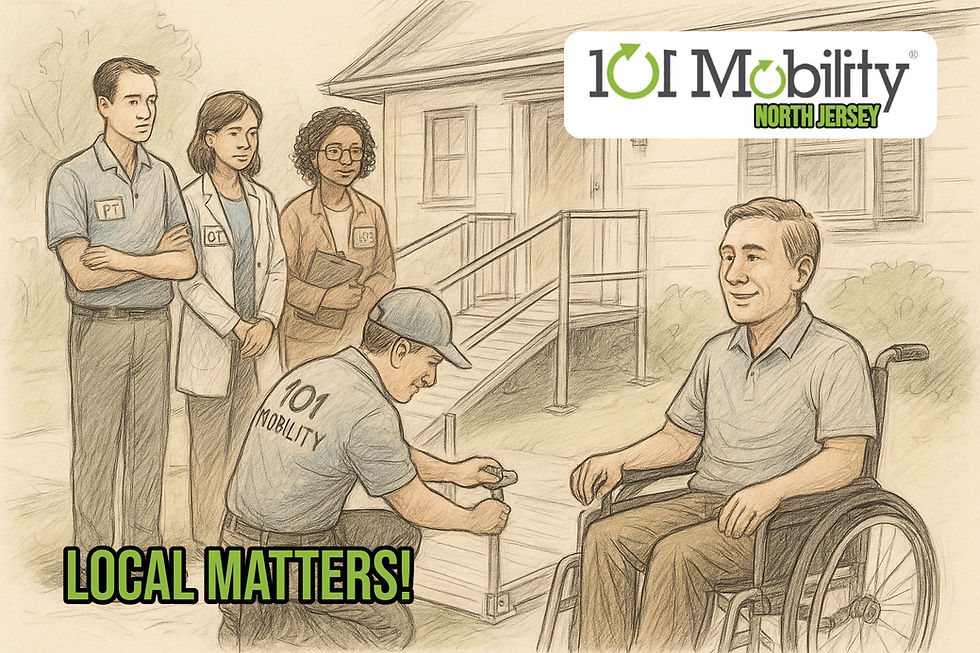
Motivation In Motion: How Rehab Professionals Can Inspire Confidence in the Journey Home

As physical therapists, occupational therapists, and social work professionals, you do more than restore mobility — you restore hope. Every patient you discharge represents more than a medical success; they represent the start of a new chapter in independence. Yet one of the greatest challenges you face happens in that transition between the hospital and home — the moment your patient begins to wonder, “Can I really do this on my own?”
Helping patients prepare both physically and emotionally for returning home requires more than clinical skill. It demands empathy, motivation, and communication that empower them to believe in their progress. At 101 Mobility North Jersey, we work closely with rehab teams every day to ensure that the home environment supports your patient’s hard-won independence. Along the way, we’ve learned that the most powerful motivator isn’t just equipment — it’s connection.
Here are five ways you can motivate your patients for a confident, successful transition home:
1. Shift the Focus from Loss to Possibility
After an injury, surgery, or illness, many patients focus on what they can’t do anymore — stairs, bathing, walking, or even leaving the house safely. That mindset can quietly erode motivation.
When you reframe their perspective toward possibility, it changes everything. Instead of saying, “You may not be able to manage the stairs,” try, “With the right support and a stairlift, you’ll be able to reach every part of your home safely.”
This subtle shift gives patients permission to dream again. They begin to see solutions, not barriers — and that outlook can reignite their drive to participate fully in therapy.
2. Connect Goals to Daily Life
Clinical goals — range of motion, gait training, fine motor skills — are important, but they don’t always translate emotionally. Patients are more motivated when they can see the why behind the work.
Instead of “Let’s work on your hip strength,” say, “Let’s get you strong enough to climb your front steps again.” When a patient’s therapy connects directly to their home environment, motivation skyrockets.
PTs and OTs can take it a step further by asking patients to describe their home setup and identify what daily activities matter most — getting to the kitchen table, taking a shower independently, or going outside to garden. Once those personal goals are on the table, therapy becomes about life, not just recovery.
3. Celebrate Micro-Wins
Motivation thrives on momentum. Each small success — one less cue, one more step, one extra minute of endurance — deserves acknowledgment.
Rehab professionals know progress isn’t linear, and neither is confidence. Celebrating the “small victories” gives patients evidence that change is happening, even when they can’t see it.
A quick high-five, a shared laugh, or a milestone photo at discharge can create emotional markers that reinforce their belief in themselves long after they’ve gone home.
4. Address Fear Honestly — Don’t Dismiss It
Fear is often the quiet barrier to progress. Patients may fear falling, losing independence, or being a burden to their families. Dismissing those fears with “You’ll be fine” can unintentionally make them feel unheard.
Instead, validate their concern: “I understand that you’re worried about those stairs — let’s talk about what can make them safe.” That moment of empathy builds trust and opens the door to problem-solving.
This is also where discharge planning partnerships matter. When you can tell a patient, “We’ve partnered with a local team that installs ramps and stairlifts before discharge,” fear is replaced with reassurance. Confidence grows when concrete solutions are within reach.
5. Make Motivation Part of the Discharge Plan
Social workers and rehab directors know that discharge is not the end — it’s the bridge. Motivation should be written into the plan as clearly as medication or follow-up appointments.
Encourage families to continue celebrating progress. Suggest visual cues — a whiteboard for daily wins, or photos of their therapy milestones displayed at home. Recommend local support services or accessibility providers who can make the environment safer and less stressful.
At 101 Mobility North Jersey, we’ve seen firsthand how the right environment transforms motivation. When a patient returns to a home equipped with safe entry ramps, grab bars, or a stairlift, their confidence grows exponentially. They participate more fully in home exercises, move with less fear, and report greater independence.
The Power of Partnership
You are the lifeline between hospital and home. When your compassion meets our accessibility expertise, we create a complete circle of care — one that empowers patients not only to return home but to thrive there.
If your rehab team would like to learn more about how we help prepare homes for safe discharges, contact 101 Mobility North Jersey at (973) 447-3975 or visit 101 Mobility North Jersey today!
Together, we can help your patients step back into life — motivated, supported, and ready for what comes next.
#PhysicalTherapists #OccupationalTherapists #SocialWorkers #DischargePlanners #DischargePlanning #PatientRehabilitation #Aginginplace #101MobilityNorthJersey #VisitingAngelsWayne